Filipino Marketer vs Marketing Agency: What You Actually Get for Your Money
Start with one question
Before the table, before the rate comparison, before any of it: write down what you need built over the next 90 days. Then for each item, ask one question.
If this were built wrong, how would I find out?
If the answer is "I'd see it immediately" — a post, an ad, a landing page, a newsletter — hire solo. You are the QA layer, and you're a good enough one. If the answer is "I'd find out in a quarter when the numbers look off" — automations, attribution, data pipelines, anything with merge fields or date logic — you need a second pair of eyes built into the process before the work ships, not after.
That's the whole decision. Everything below is just detail on why.
What you're actually buying in each case
| Solo Filipino marketer | Marketing agency | |
|---|---|---|
| What you buy | Hours and execution | A system and an outcome |
| Who decides strategy | You | The agency (ideally with you) |
| Who QAs the work | You | Someone other than the person who built it |
| Coverage when they're out | None | Bench |
| Tooling cost | Yours | Usually included |
| Best fit | You already know what to do | You don't, or you don't want to |
That middle row is where most of the money gets lost. With a solo hire, the person who built the work is usually also the person approving it. If you're not technical enough to audit the output yourself, the risk is that there's no QA layer at all — and you find out something's broken when revenue drops.
That's a risk, not a prediction. Plenty of solo hires catch their own mistakes. The point is that nothing in the structure forces it.
The question behind the question
When someone searches "filipino marketer vs marketing agency," they usually mean one of two things. Either: I can hire a Filipino marketer for a fraction of a US agency retainer, so why would I pay the agency? Or: I already tried hiring a solo marketer and it didn't work, so should I just go with an agency now.
Both are fair. I run a marketing systems and AI development agency staffed by Filipino talent serving US businesses, so I sit on an odd side of this. I'm the agency. I'm also the Filipino marketer. I've seen both models work and both models fail, and the failure pattern is almost never about skill.
What the QA gap looks like in practice
The hidden gaps between the CRM and the app
We documented an 11-workflow welcome series for a marketing agency's automation stack. The GoHighLevel side looked clean. Workflows firing, tags applied, emails going out.
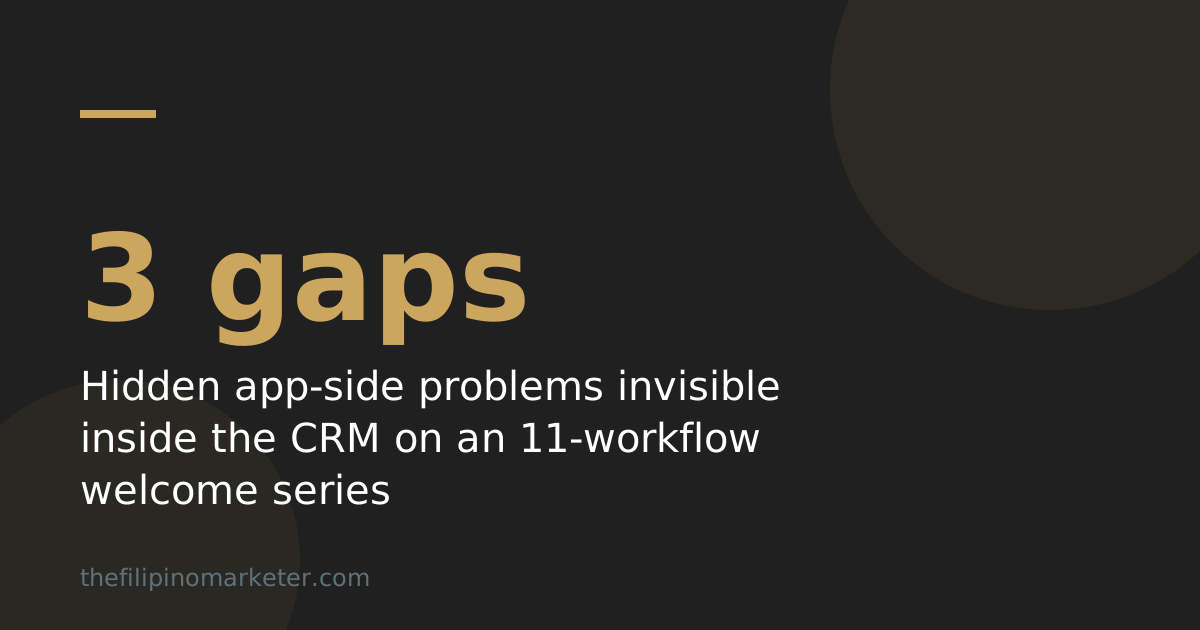
Then we cross-checked the build spec against the live edge functions. Three problems showed up that were completely invisible inside the CRM: a hardcoded segment value, a missing consent-given tag on one channel, and three custom fields that were never pushed to GHL at all.
Nothing in the CRM reporting would have flagged any of that. You'd see sends, opens, clicks. You'd just be segmenting people wrong and running one channel without a consent tag. If the person you hired only has access to the CRM, they have no way to catch this — not because they lack skill, but because half the system is outside their scope.
The campaign that launched with 25 leads on purpose
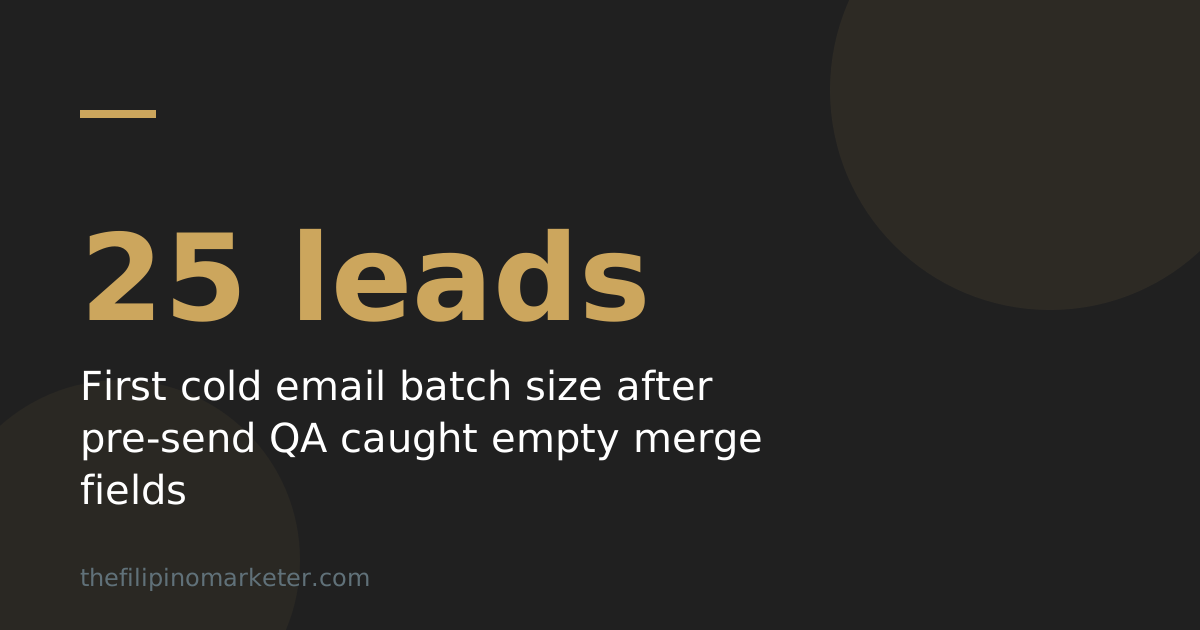
Cold email engine setup for an AI voice agency pivoting its offer to a free AI Audit. Pre-send QA on the Instantly campaign found empty icebreaker and segment merge fields in the list. So we launched the first batch with only 25 enriched leads instead of the full list, and filled the rest before the next send.
The risk when one person owns both the sending and the reporting is that pressure to show activity wins — the full list goes out, merge fields render blank, the first impression is broken, and the domain takes the hit. Sending 25 instead of 2,500 is easier when the person making the call isn't being measured on volume that week.
Where the solo Filipino marketer genuinely wins
I'm not going to pretend the agency is always right.
- You already have the strategy. If you know your offer, your channels, and your numbers, and you need someone to execute, a solo hire is cheaper and faster. You're paying for hands, and hands is what you need.
- One channel, steady state. Running paid social on an established account. Posting and community management. Monthly reporting. Narrow and repeatable work suits one person.
- You want direct control. No account manager layer. You brief them, they do it. Some owners strongly prefer this and they're not wrong.
- Long-term, you can build a team. A good first hire becomes your in-house lead. That's a real path and I've seen it work.
The talent pool is genuinely deep. English fluency is not a concern. The constraint is structural, not individual — one person can only hold so much of a system in their head, and by default nobody reviews their work.
Where the agency genuinely wins
- Multi-system builds. CRM plus app plus email plus data. The moment the work crosses two systems, somebody has to own the seams. Those three GHL gaps lived in the seam.
- Anything with code in it. Dependency versions, deploy pipelines, environment config. These are thirty-second fixes if someone knows to look and multi-day outages if nobody does.
- Reporting you'll make decisions on. Revenue views live or die on date logic — which date a number is counted against changes every figure on the dashboard. Get it wrong and the output is wrong in a way that still looks plausible.
- Speed to coverage. You're not waiting on one person to learn a new tool.
The cost comparison nobody runs properly
Most people compare the solo marketer's monthly rate to the agency retainer and stop there. The honest comparison includes:
- Your own hours managing, briefing, and reviewing
- Tool subscriptions you now pay directly
- The cost of work that was wrong and nobody caught
- Rehiring and re-onboarding if it doesn't work out
That last one is bigger than it looks. Onboarding — accounts, access, context, standards, the way you want things done — is a cost you pay in full on every hire. An agency pays it once internally and amortizes it across clients. If you hire solo, you absorb it yourself, from scratch, each time.
Questions people actually ask
What's the difference between a marketing firm and a marketing agency?
In practice, nothing consistent. Some firms lean consulting and strategy, some agencies lean execution. Don't pick based on the word. Ask who does the work and who reviews it.
Is it worth it to hire a marketing agency?
If the work spans more than one system, or if you can't personally audit the output, yes. If you can hand someone a clear brief and verify the result yourself, a solo hire is cheaper and probably better.
Which marketing company is the best in the Philippines?
Wrong question. The directories will give you a list. The better question is whether the people doing your work have ever cross-checked a CRM build against the application behind it, and whether they'll tell you when something's broken before you find out from your numbers.
Where that leaves you
Run the 90-day list. Mark each item with how you'd find out it was built wrong. If most of the list is "immediately," hire one person and brief them well. If most of it is "a quarter from now," the thing you're actually buying isn't hours — it's review.
If you want to talk through which side of that line your work falls on, you can grab a time on my calendar. If the honest answer is that you should hire one person instead of an agency, I'll tell you that.