
Filipino Telemarketers: What They Actually Cost, Where They Work, and How to Not Waste Your Money
The short answer
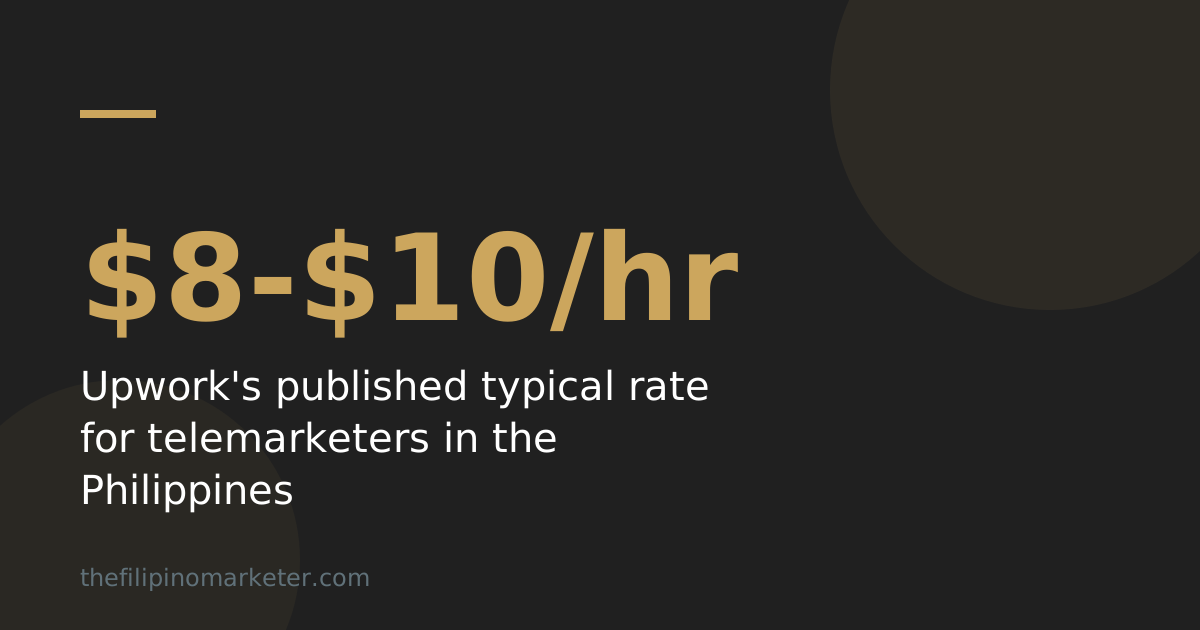
Filipino telemarketers are cheap, available, and usually good on the phone. Upwork lists typical hourly rates for telemarketers in the Philippines at $8-$10 per hour (checked at the time of writing, 2025). Agencies and BPOs charge more, usually because they bundle a supervisor, a QA layer, and a seat.
That part is easy. The hard part is everything around the caller — including the rules you have to follow when you dial US numbers.
What I do and do not do
Let me be clear about where I am standing, because it changes how you should read the rest of this.
I do not run a call floor. I am not going to quote you my own contact rates or my own cost per booked appointment, because I do not have callers dialing for clients. If someone selling you a calling team cannot show you theirs, that should bother you. It should also bother you if I pretended to have them.
What I run is a marketing systems and AI development agency. I am Filipino, most of my team is Filipino, and the work I get paid for is the layer underneath the caller — lead routing, dispositions, CRM plumbing, dashboards, alerting when a feed goes quiet. I have watched plenty of US businesses hire a Filipino caller, get nothing, and decide Filipino telemarketers do not work. In most of those cases the caller was not the problem. The list was bad, the offer was bad, or nobody could see what happened after the call ended.
So treat this as a buyer's guide from the systems side, not a sales pitch for calling hours. And I am not a lawyer — the compliance section below is orientation, not legal advice.
Why the Philippines, specifically
- English is a working language, not a second language. Instruction in most schools is in English. Neutral-to-mild accent is common.
- Time zone math works. Manila is 12-13 hours ahead of US Eastern depending on the season. A 9am-5pm EST shift is a night shift in Manila. That is normal here. The entire BPO industry is built on it.
- Service culture. Filipino callers tend to be polite and patient on the phone. On cold outbound that can cut both ways — polite is good, but a caller who will not push back on a soft objection will not set appointments. This is worth testing rather than assuming: in your mock call, throw a soft "I'm not really interested right now" and see whether they fold or ask one more question.
- Depth of talent. There are hundreds of telemarketing and contact center firms here. You are not picking from a thin pool.
What it actually costs
I only have one published number to work from, so let me be honest about that and then do the arithmetic properly instead of hand-waving. The number is Upwork's, as published at the time of writing in 2025: $8-$10 per hour for telemarketers in the Philippines. Rates move, so re-check it before you budget. Everything below is that number multiplied out.
Direct hire, full time, run the math
| Commitment | At $8/hr | At $10/hr |
|---|---|---|
| Part time, 20 hrs/week | $160/week | $200/week |
| Full time, 40 hrs/week | $320/week | $400/week |
| Monthly (173 hrs) | $1,384 | $1,730 |
| Annual (2,080 hrs) | $16,640 | $20,800 |
So one full-time Filipino caller lands somewhere between roughly $16,600 and $20,800 a year at the published marketplace rate. That is the whole ballpark for a direct hire. Add platform fees if you hire through a marketplace, and add a laptop and headset if you are supplying equipment.
What the other routes add on top
I am not going to publish rate cards for staffing firms or BPOs, because I do not have their numbers and I am not going to make them up. What I can tell you is what they are charging you for, so you know what to ask about when you get a quote.
| Hiring route | Basis for the price | What you are buying on top of the caller |
|---|---|---|
| Freelance marketplace (Upwork, OnlineJobs.ph) | Hourly, $8-$10/hr published | Nothing. A person. You manage them, you build the process, you own QA and compliance. |
| Staffing / seat provider | Usually a monthly seat fee | Recruiting, HR, payroll, equipment, office or managed WFH setup, sometimes a team lead |
| Full BPO campaign | Per hour or per seat, usually with a minimum seat count and a contract term | Supervisor, QA scoring, reporting, backfill if someone quits, dialer and telephony |
Three questions to ask any staffing firm or BPO so you can compare their quote against the $8-$10 baseline:
- What is the all-in monthly cost per seat, including telephony and any dialer license?
- What is the minimum seat count and minimum term?
- What happens to the price if I need one seat instead of five?
Take their monthly number, divide by 173 hours, and you have an effective hourly rate you can put next to $8-$10. If their effective rate is 2x the marketplace rate, that is not automatically bad — you are buying supervision and continuity. Just make sure you know you are buying it.
The number that actually matters
Hourly rate is the least interesting cost in this whole exercise. Cost per booked appointment is the one that decides if this works. Use your own figures, but the shape of the math is this:
Monthly cost ÷ appointments set per month = cost per appointment.
At the $1,384/month end of the table, a caller setting 20 appointments a month costs you about $69 per appointment. The same caller setting 8 a month costs you $173. Same person, same rate, same contract — the difference is entirely list quality, offer, and whether anyone is coaching them. That is a 2.5x swing you control and the hourly rate does not.
So: direct hire is cheapest and highest variance. BPO is most expensive and lowest variance. Most small US businesses should start with one direct hire, get a real cost-per-appointment number on the board, and only move up when the process is proven.
The reason most of these hires fail
Go read the realtor threads on Reddit where people complain about Filipino call centers. In the ones I have read, the complaint is rarely "I could not understand them." It is usually that the calls are spammy, high volume, low relevance, and obviously reading a script to a list someone scraped.
That is a campaign design problem. If you hand a caller 4,000 unqualified numbers and tell them to dial, you will get 4,000 annoyed people and a handful of garbage leads. The caller did exactly what you asked.
What changes outcomes, in order of impact:
- List quality. Narrow, recent, matched to your actual offer. A list of 300 good fits beats 5,000 scraped rows every time.
- A reason to call. Inbound follow-up, form abandons, past customers, event registrants, expired quotes. Warm beats cold by an enormous margin, and it is easier on the caller's morale.
- Script flexibility. Give the first 20 seconds verbatim and let the caller think after that. Rigid scripts are what make calls sound like calls.
- A place for the outcome to land. Every dial needs a disposition. Every booked call needs a calendar entry. If this lives in a spreadsheet nobody opens, the campaign is already dead.
The part nobody budgets for: the system behind the dialer
This is the part I actually get hired for, so here is what I have seen go wrong in adjacent work.
You need to see, every day: dials made, contacts reached, appointments set, appointments that showed, and cost per booked appointment. If you cannot pull those five numbers in under a minute, you are managing on vibes. Your caller will be judged on effort instead of output, which is the fastest way to end up with a busy person and no pipeline.
And reporting breaks in boring ways. I was debugging a missing spend-guardrail tile on a mortgage brokerage's internal lead dashboard recently. The tile looked broken. The token was fine. The actual cause was that the Meta Marketing API call was being made from the browser, and the operator's ad blocker was silently killing it. Moving the call server-side fixed it. The team had spent days half-trusting a dashboard that had been correct the whole time.
Same category of problem on the automation side. On an internal marketing-automation platform, I built failure alerting for scheduled jobs that only fires after two consecutive failures, so one flaky run does not spam anybody. The end-to-end test caught an off-by-one bug that would have suppressed alerts during a real outage. If that had shipped, lead routing could have gone down quietly.
Apply that to calling. If your lead feed stops on a Tuesday and nothing alerts, your caller spends the rest of the week dialing a stale list and you blame the caller. Silent failure is the enemy.
How to hire one, concretely
1. Decide what the job actually is
"Telemarketer" covers cold outbound, warm follow-up, appointment setting, list qualification, and inbound overflow. These are different skill sets. Appointment setters who are great at warm follow-up are often mediocre at pure cold, and vice versa. Write the job for one of them.
2. Interview on the phone, not over chat
Obvious, but people skip it. Call them unannounced within the window they said they are available. Listen for pace, filler words, and whether they ask you questions. A caller who asks you questions in an interview will ask prospects questions on a dial.
3. Run a paid mock call
Give them a one-page offer brief and your top three objections. Pay for an hour — at the published rate that costs you $8 to $10. Have them call you twice, once as a cold prospect, once as a warm one. Use one of those calls to test the soft-objection handling I mentioned earlier. You will know in ten minutes. There is no cheaper screening test in hiring.
4. Set a 30-day scorecard before day one
Dials per shift, contact rate, appointments set, show rate. Agree on the numbers in writing. Review weekly, not monthly. And decide before day one where those numbers come from — if the answer is "the caller will tell me," you have a problem.
5. Pay on time, in full, every time
I will be direct since I am on this side of it. Late payment is the fastest way to lose a good Filipino hire. The talent market here is tight and word moves. Pay reliably and you will keep people for years.
Compliance: the rules follow you, not the caller
This is the section people skip and then regret. If you are a US business calling US numbers, US telemarketing law applies to those calls — it does not stop applying because the person dialing is in Manila. You are the seller. The exposure is yours.
I am not a lawyer and none of this is legal advice. Treat it as the list of things to raise with counsel before your first dial.
- TCPA. The Telephone Consumer Protection Act is the big one, mostly because it carries a private right of action and per-call statutory damages. It restricts autodialed calls, prerecorded messages, and artificial voices — particularly to mobile numbers — and marketing calls of that kind generally require prior express written consent. A human dialing manually sits in a different place than an automated dialer, which is exactly why the dialer you choose is a legal decision, not just a tooling one.
- FTC Telemarketing Sales Rule (TSR). Governs outbound telemarketing to consumers. It requires prompt, truthful disclosure of who is calling and that the purpose is a sale, prohibits misrepresentation, and imposes record-keeping obligations. B2B calling is treated more narrowly under the TSR, but "narrower" is not "exempt" — confirm where your offer falls.
- Do Not Call. Scrub against the National Do Not Call Registry, and maintain your own internal do-not-call list. Access to the registry involves registration and, depending on how many area codes you pull, fees. Internal opt-outs need to be honored immediately and permanently, which means your CRM needs a DNC field your caller cannot forget to set.
- Calling hours. The TSR window is 8am to 9pm in the prospect's local time, and some states are stricter. This matters more than usual with a Manila team: your caller is working a night shift and the clock on their wall is meaningless. Build the time zone into the list and the dialer, not into a rule you hope they remember at 3am.
- Call recording consent. Recording law is state by state. Some states are one-party consent, some require all parties to consent, and your prospects will be spread across both. If you record — and for QA you probably should — the safe default is to announce it at the top of every call and log that you did.
- Honest caller ID. The TSR requires transmitting accurate caller ID with a number that reaches you back. Using a US number for a Manila-based caller is fine when it is a real number you own and answer. Spoofing a number you do not control, or rotating numbers to dodge spam labels, is where this turns into a Truth in Caller ID Act problem.
- AI voice calls. Treat them as the strictest case. The FCC has made clear that AI-generated voices in robocalls count as artificial voices under the TCPA, which pulls them into the prior-express-consent requirements. Several states have layered their own disclosure rules on top. "It sounds human" is not a defense — if anything, it is the problem.
Practical version: write the rules into the system rather than the training deck. DNC check before a number can enter the dial queue, local-time gating on the list, recording disclosure in the first line of the script, one caller ID number that you own. Then have counsel review the script, the consent language, and your dialer setup before anyone picks up a headset.
Where the AI question fits
You will get pitched AI voice agents as a replacement. My honest read: AI is excellent at the layer around the caller and still shaky at being the caller on anything with a real objection — and, as above, it is the most legally loaded way to make an outbound call.
- List enrichment and scoring before anyone dials
- Call transcription, summary, and auto-disposition into the CRM
- Drafting the follow-up email or SMS within 60 seconds of the call ending
- Flagging calls where the caller missed an obvious buying signal
That combination makes one good human caller meaningfully more productive. It does not replace them. And it means your caller spends their shift talking instead of typing notes — which, at a fixed hourly rate, is the cheapest productivity gain available to you.
Budget: start smaller than you think
Do not launch with three callers. One caller at $1,384-$1,730 a month is a test. Three is a department, and you will not know which one of them is working. Launch with one, prove the unit economics, then add.
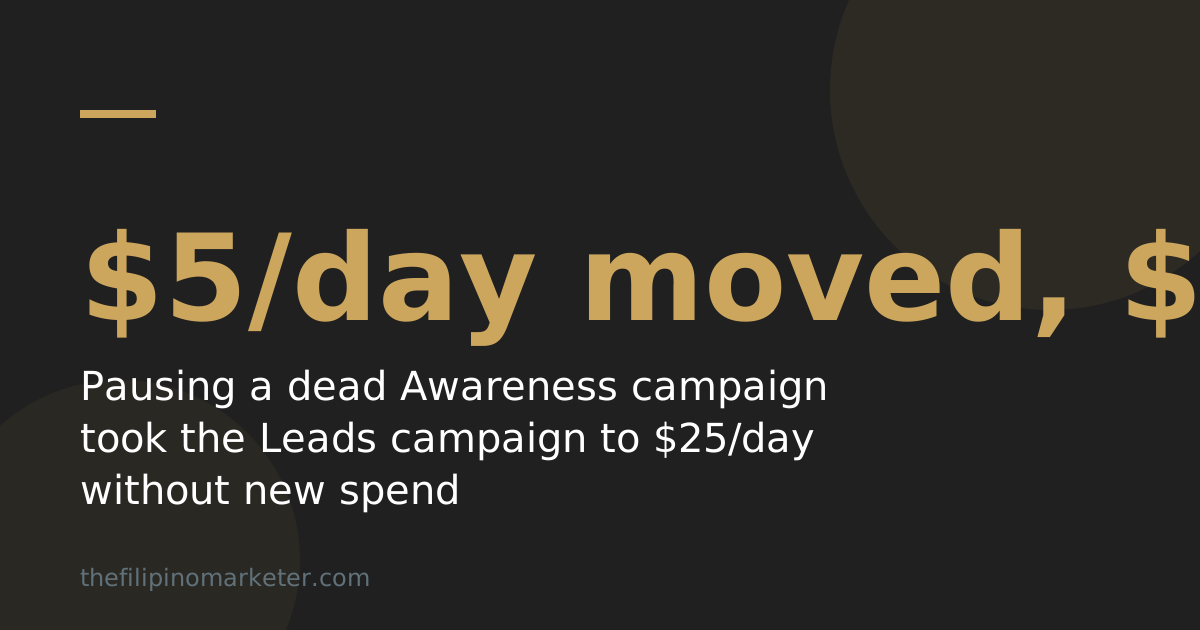
Same logic I use on ad spend. On a recent campaign fix for an event marketplace recruiting vendors through Meta, I paused an Awareness campaign that was not producing and rolled its $5/day into the Leads campaign — bringing that campaign to $25/day without adding a dollar of net new spend. Reallocation first, expansion second. Find the configuration that works, then feed it.
Common questions
What is the average salary for a telemarketer in the Philippines?
On freelance marketplaces, Upwork listed typical telemarketer rates in the Philippines at $8-$10 per hour as of 2025. Full time at 173 hours a month, that is $1,384 to $1,730. Local in-office BPO salaries are structured differently — monthly, plus night differential and allowances — and vary widely by city and account.
What does a full-time Filipino telemarketer cost per year?
At 2,080 hours, roughly $16,640 at $8/hr and $20,800 at $10/hr, before platform fees and equipment.
Where do I find Filipino telemarketers and VAs?
Upwork and OnlineJobs.ph for direct hires. Staffing providers and BPOs if you want a managed seat. Referral is underrated — good Filipino callers know other good Filipino callers.
Does US telemarketing law apply if my caller is overseas?
Assume yes. The obligations attach to the business making the sale, and the calls are landing on US phones. Your contract with a BPO may allocate some responsibility, but regulators and plaintiffs will come to you. Ask counsel how your specific setup is treated.
Do telemarketers still exist?
Yes, and the economics have gotten better for the buyer, not worse. Email and ads got more expensive and noisier. For a lot of small businesses, a human who can hold a conversation still converts better than the alternatives — though that depends heavily on your offer and list. What changed is that pure cold spray-and-pray barely works. Targeted calling into a warm or well-defined list still works fine.
Will prospects know the caller is offshore?
Sometimes, and it matters less than people assume. What kills a call is irrelevance, not accent. Be upfront, use a US number you actually own, and make sure the caller actually understands the product.
The one-line version
Filipino telemarketers are a good buy at $8-$10/hr, or about $1,400-$1,700 a month full time. The caller is rarely your bottleneck. Your list, your offer, whether you can see the numbers, and whether the compliance rules are built into the system — that is your bottleneck. Fix those first and the hire pays for itself. Skip them and you will blame the caller for a system you never built.
If you want help with the system part
To be plain about what I sell: not calling hours. I build the layer your caller plugs into — the list pulls, the lead routing, the disposition fields, the daily scorecard, and the alerting that tells you when a feed stops. If you already have a caller and cannot answer "what did we pay per booked appointment last week," that is the gap I close.
If that is useful, book a short call with me here. Bring whatever you are tracking now, even if it is a spreadsheet. I will tell you if it is a fit or not — and if you just need a caller and nothing else, I will say that too. For the legal side, bring in counsel; that part is not my lane.

