
Should You Write a Book to Grow Your Business? Here's the Math
Most people who like books have thought about writing one
If you read a lot, the thought has crossed your mind. Write your own. Why not.
I've had that thought. I run a marketing systems and AI development agency for US businesses, and every so often I catch myself outlining a book in my head instead of doing the work in front of me. So I decided to look at it the way I look at any other project a client brings me. Cost in, value out. No romance about it.
Up front, so you know what you're reading: I have not published a book. I don't have a client who published one and reported back a number. What I have is the same arithmetic I run on every marketing asset before I build it, applied to this one — plus one real number of my own, which is how long it actually takes me to produce a piece of content. Where I use other numbers below, I'll tell you whether they're sourced or made up for the sake of the example.
The cost is a year, not a manuscript
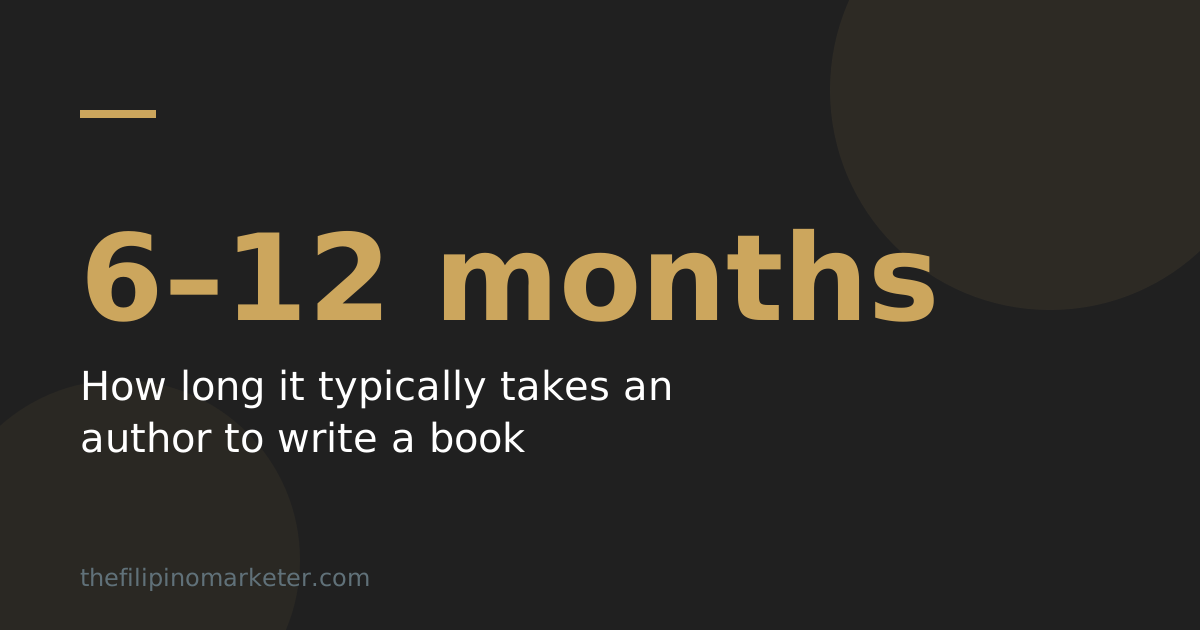
According to selfpublishing.com, a book can be written in a few hours or a few years. Typically an author takes 6 to 12 months.
That is the real line item. Not the cover. Not the editor. Not the ISBN. The 6 to 12 months.
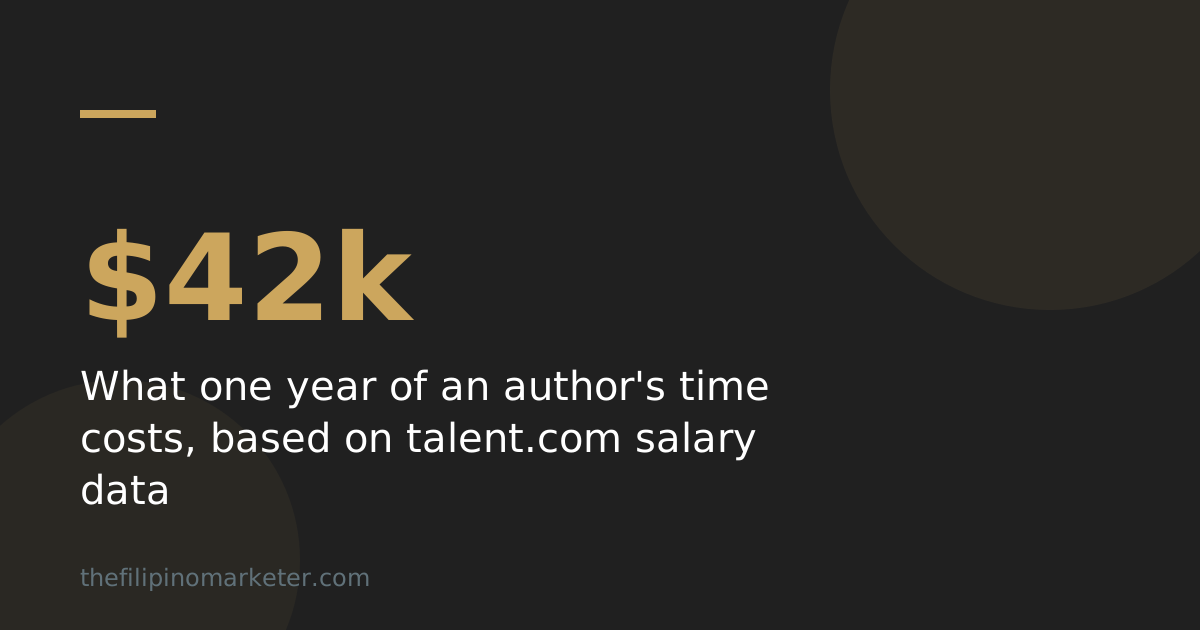
For reference on what a year of a person's time gets valued at in the open market, talent.com puts a teacher or professor at about $42k a year for 4 to 8 hours a day of teaching. I used that number in an earlier version of my own thinking and it was the wrong number.
Why the salary comparison is the wrong number
A teacher's salary is a floor, not a comparison. If you own a business, your year isn't priced at a salary. It's priced at whatever the best available use of that year would have produced.
That's the number that actually matters, and it's different for everyone reading this. A consultant billing at $200 an hour who spends 300 hours on a book has spent $60k. An owner who could have spent those 300 hours building a referral partner program, or fixing a sales process that leaks half its leads, has spent whatever that program would have produced. Sometimes that's more than $60k. Sometimes it's nothing, because the alternative was scrolling.
So the first thing I'd do is not price my time against a teacher. I'd price it against the next best thing on my own list.
The right question: what does the book feed?
Most "should I write a book" advice stops at royalties. Royalties are the least interesting part of this for a business owner. If you're selling services, the book is a marketing asset, so judge it like one.
Here's what I'd want it to feed:
- Inbound leads. Does the book have a next step in it? A page, an assessment, a booking link. If not, it's a business card that took a year.
- Close rate. Sending a book before a sales call is different from sending a case study. Whether it moves the number is measurable. Track calls with the book sent versus without.
- Deal size. Authority tends to affect what you can charge more than how many people call. That shows up in average contract value, not lead volume.
- Speaking. Events want speakers with books. Whether those events contain your buyers is a separate question you should answer before you write, not after.
- Referrals. A book is easy for someone else to hand over. Harder to hand over a website.
Notice that four of those five have nothing to do with book sales. That's the point. The economics of a business book usually live downstream of the book.
How you'd actually measure those
This is the part I do build for clients, and it's not complicated. One dedicated URL that appears only inside the book, so any traffic there can only have come from a reader. A checkbox or field in the CRM marking whether a book went out before the call, set at the time you send it, not backfilled from memory. Then you compare close rate and average deal value across those two groups.
You need enough calls for the comparison to mean anything. If you run 8 sales calls a quarter, you won't know anything for a year. If you run 40 a month, you'll know in two months. Worth knowing which one you are before you start, because it tells you when you get an answer.
How I'd model it before writing a word
I'd fill in a table like this with my own numbers, honestly, before committing 6 to 12 months. Blank on purpose — these are your figures, not mine.
| Line | Your number |
|---|---|
| Hours you'd spend writing, editing, publishing, promoting | |
| Your effective hourly value (revenue you're responsible for ÷ hours worked) | |
| Total time cost (hours × hourly value) | |
| Hard costs: editing, cover, formatting, print, ads | |
| Your average deal value | |
| Deals per year the book would need to produce or influence to break even |
A worked example, anchored to one number that's real
One input below isn't invented: the 300 hours. I didn't guess at it, I measured it against my own output. This article — outline, research, drafting, editing, the two charts, publishing — took me a little over 5 hours end to end. That's my actual pace on this blog. At 6 hours a week, a year of that pace is roughly 60 published pieces, and it's the same 300 hours a 6-to-12-month book asks for. Same year, two very different assets. The rest of the figures are made up so you can see the shape of the math. Substitute yours.
- 300 hours across writing, editing, publishing and promotion. That's about 6 hours a week for a year.
- Effective hourly value of $200. Time cost: $60,000.
- Hard costs of $6,000 for editing, cover, formatting and a small ad budget.
- Total: $66,000.
Now the deal side. At a $2,000 average deal and a 30% margin on delivery, you're keeping $600 per deal, so break-even is 110 deals. At a $50,000 average deal with the same margin, it's about 4.4 deals. Same book, same year, completely different call.
Run it against your close rate too. If the book produces 60 conversations a year and you close 20% of them, that's 12 deals. Multiply by your margin per deal and see if it clears the $66k. If it doesn't clear it, the book isn't the problem — the number of conversations it produces is, and you should be honest about where those 60 conversations were going to come from.
This is why I'm skeptical when someone with a low-ticket offer tells me they're writing a book to grow. The arithmetic rarely gets there. High-ticket, long-consideration, trust-heavy sales are where a book earns its year back.
The book is not the funnel
One thing I'd push back on if a client brought this to me. A book with no system behind it doesn't compound. It sits.
The version that works has a path: the book leads somewhere, that somewhere captures contact info, and there's follow-up that isn't manual. If you're not willing to build that part, you're not making a marketing asset. You're making a souvenir.
And the flip side is true too. If you build that path and you don't have a book yet, the path still works. Articles, a small guide, a video series. Same mechanics, a fraction of the year. That's usually where I'd start, and then let the book come out of material that already proved people wanted it.
That's the order I'd defend hardest. Write 20 articles first. At my 5 hours a piece that's 100 hours — a third of the book, and you get to look at the scoreboard three times along the way. Look at which three got read and which one produced calls. Now you know what the book is about, and you've got a year of evidence instead of a year of guessing.
It's easier now than it used to be
With AI and modern publishing platforms, drafting, proofreading, formatting, and distribution have all gotten cheaper and faster. The barriers that used to stop people are a lot smaller than they were.
That cuts both ways. Lower barriers mean more books, which means the book alone proves less than it used to. What still separates one from another is having something worth saying, evidence that you've actually done the thing, and a reason for the reader to take a next step.
The hard part didn't get easier. Only the production did.
So should you do it?
Run your own version of the math. What a year of your time is worth against the next best use of it. What your average deal is. How many deals the book has to touch to pay for itself. Whether the speaking rooms it opens have your buyers in them.
If those numbers line up, write it. If they don't, you probably want the system, not the book. Sometimes you want both, in that order.
If you're weighing a book, a content system, or an AI workflow as a way to grow, I'm happy to talk it through and help you fill in that table with real numbers. Book a time here if that's useful.

